Unit 2: GDP (Real and Nominal)
- GDP (gross domestic product): The total market value of goods and services produced within a country's borders within a given year.
- GNP(gross national product): A measure of what its citizens produce and whether they produce these items within its borders.
What is not included in GDP:
- Used or second hand goods.(Avoid double or multiple counting)
- Gifts/ transfer payments. (Come in public or private)(No output being produced).
- Public: welfare and social security
- Private: scholarship
- Contribute nothing to current production.
4. Unreported business activity: (Tips)
5. Illegal activities: (drugs, prostitution, etc…)
6. Intermediate goods: goods that requires further processing before they are ready for final use. (ex: big mac: cheese, buns, etc)
7. Non-market activities: Anything you volunteer to do, or family work.
Expenditure Approach
GDP= C+Ig+G+Xn
C=personal consumption expenditures: purchase of finished goods and services. (67% of the economy spends their money here)
Ig= gross private domestic investment: (Covers new factory equipment. Factory equipment maintenance. Construction of housing. Unsold inventory of products built in a year
G= government spending. Govt. is buying finished goods and services
Xn= Net exports. Exports-Imports.
Income Approach
- Add up all of the income that resulted from selling all final goods and services produced in a given year.
****WRIP (wille rest in peace)
- Wages (Salary supplement, compensation of employees)
- Rents (Rental Income)
- Interests (Interest Income)
- Profits (Proprietor's Income)

Nominal VS Real GDP
Nominal GDP-(current prices)
- The value of output (quantity) produced in current prices
- Formula: P X Q
- Can increase from year to year if either output or price increases.
- The value of output produced in constant base year prices that is adjusted for inflation.
- Formula: P X Q
- Can increase from year to year if only output increases
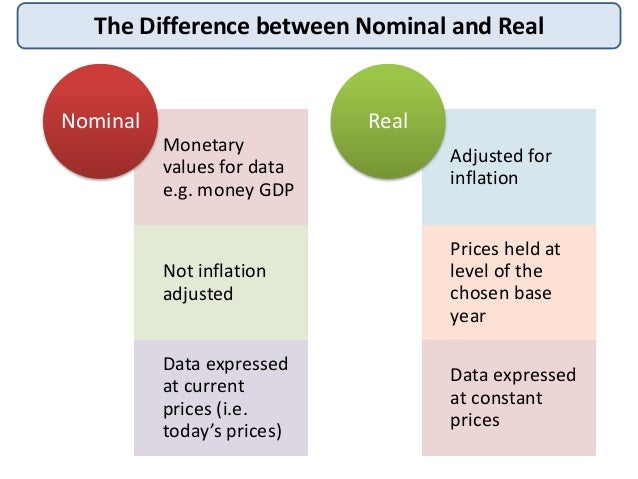
****In the base year, the current prices equal to constant prices
- Base year- Nominal GDP= Real GDP
- In Years after the base year nominal GDP WILL EXCEED real GDP
- In years before the base year real GDP will exceed nominal GDP
GDP deflator:
- A price index used to adjust from nominal to real GDP
- Formula: ((nominal GDP)/(real GDP)) x 100
- In the base year the GDP deflator will equal 100
- For years after the base year, GDP deflator will be greater than 100.
- For years before the base year, GDP deflator is less than 100
- Inflation: a general rise in price level
- Inflation rate: ((new price index)-(Old price index))/(Old price index) X 100
-Consumer price index (CPI): measures the cost of a market basket of goods of a typical urban american family.
- (Cost of a market basket of goods in a given year)/ (Cost of a market basket of goods in the base year) X100
Other Formulas:
- Trade:
- Export-Import
- If the number is negative, it is a deficit.
- If the number is positive, it is a surplus
2. Budget:
- (Government Purchases of Goods and Services) + (Government Transfer Payments)-(Government Tax and Fee Collections)
- If the number is negative, it is a surplus
- If the number is positive, it is a deficit
- Option 1: (Compensation of employees)+(Rental Income)+(Interest Income)+(Proprietors Income)+(Corporate Profits)
- Option 2: (GDP)-(Indirect Business Taxes)-(Depreciation or Consumption of fixed capital)-(Net Foreign Factor Payment)
- (National Income)-(Household Taxes)+(Government Transferred Payments)
- (GNP)-(Depreciation)
- (GDP)-(Depreciation)
- (GDP)+(Net Foreign Factor Payment)
- (Net Private Domestic Investment)-(Depreciation)
For future reference, in any hypothetical situation, the expenditure approach will be of the same value of income approach, so you don't have to calculate income, regardless if they provide you with everything you need to calculate it!
ReplyDeleteAn example for GNP is if Ford, an American company, were to have production in Dubai. The GNP would still include this.
ReplyDeleteI loved the post it was very informative but I would like to add (the ratio is calculated by dividing the price of the exports by the imports, with the result then being multiplied by 100)
ReplyDelete