Unit 1: Demand
Demand: The quantities that people are willing and able to buy at various prices.
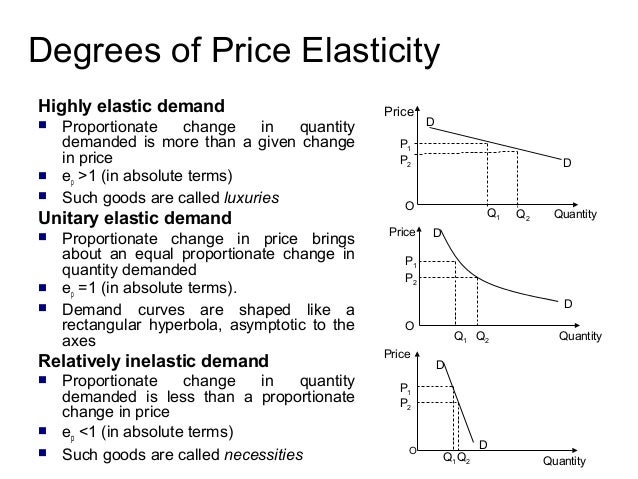
Elasticity of demand: A measure of how consumers react to a change in price.
Inelastic demand: Demand will either not change, or change very little , regardless of price. (Needs).
- Few to no substitutes
- Ex: Gas, water, milk, soap, insulin
-E<1
Elastic demand: Demand changes greatly where there is a change in price.
-E>1
Unitary demand: Change in the price of the good, causes an equal change in the quantity demanded.
-E=1
The Law of Demand: There is an inverse relationship between price and quantity demanded (As price increases, quantity decreases).
- A change in price causes a change in quantity demanded.
Formulas:
▲in quantity or price= (new-old)/old
Price elasticity of demand= (%▲in quantity) / (%▲in price)
Total Revenue= Price X Quantity


Demand curves are always downward sloping.
Elasticity of demand: A measure of how consumers react to a change in price.
Inelastic demand: Demand will either not change, or change very little , regardless of price. (Needs).
- Few to no substitutes
- Ex: Gas, water, milk, soap, insulin
-E<1
Elastic demand: Demand changes greatly where there is a change in price.
-E>1
Unitary demand: Change in the price of the good, causes an equal change in the quantity demanded.
-E=1
The Law of Demand: There is an inverse relationship between price and quantity demanded (As price increases, quantity decreases).
- A change in price causes a change in quantity demanded.
Formulas:
▲in quantity or price= (new-old)/old
Price elasticity of demand= (%▲in quantity) / (%▲in price)
Total Revenue= Price X Quantity
Causes of "Change in demand":
- ▲in buyer's tatse (advertisement)
- ▲in the number of buyers (population)
- ▲in income (*normal and **inferior goods)
- ▲in the price of related goods (***substitute and *****complementary goods)
- ▲in expectations
*Goods that buyers buy more of when their income rises.
**Goods that buyers buy less of when their income rises.
***Good that serve roughly the same purpose to buyers (Pepsi and Cola).
****Goods that are often consumed together.
Demand curves are always downward sloping.
Remember that when calculating the price elasticity of demand, you must always take the absolute value your answers. Your answer for PED should NEVER be a negative number.
ReplyDelete